

Fecha de publicación: 20/10/2016
Basque youth and social networks

- Almost all young people use some type of social network
- The social networks to which young people in the Basque Country connect most widely every day are WhatsApp, Facebook, Instagram and YouTube
- Girls prefer social networks that can be used to interact and share images
- After WhatsApp, Instagram is the most widely used social network by young people under 20, while older people prefer Facebook
- Young people connect to three social networks each day on average. The favourite combination is WhatsApp, Facebook and YouTube
- Last year, slightly more than one third of young people used social networks to promote or disseminate discussions or report issues
- Cyber activism increases with age, studies, interest in politics and the wish to engage in public affairs
- The most frequently used form of harassment on social networks is excluding someone from WhatsApp groups
- 4.5% of Basque youth have experienced harassment on social networks
Basque youth and social networks
 The social networks play a daily role in the lives of Basque youths. They are a new form of relating and of communicating. However, besides their many benefits, they also pose risks. This study will try to quantify the use of the various social networks outlets by Basque youths aged 15 to 29. We shall analyse their preferences based on age and sex, discover how many young people have used them to report or discuss issues and how many have experienced rejection or harassment.
In virtue of the dynamic nature of social networks, the Basque Youth Observatory considers that someone uses a social network when they connect to it at least once a week. Any person connecting less frequently is not considered a social networks user.
[up]
Almost all young people use some type of social network
Based on our definition, 99% of Basque youths aged 15 to 29 use some type of social network. On average, Basque youths use four social networks (3.8 to be more accurate).
This figure has been determined by presenting young people with a list of social networks (including some smartphone applications) and asking how often they use them. The social networks proposed were the following:
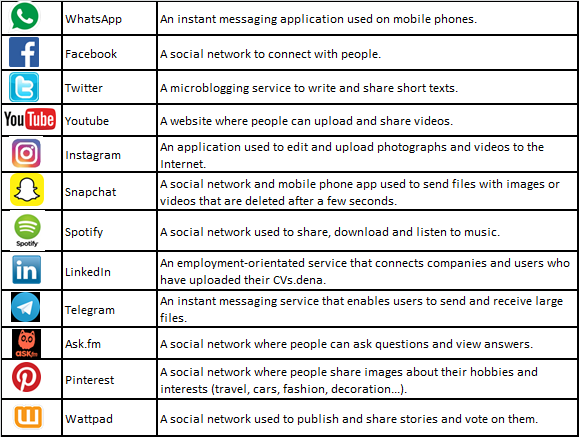
The young people surveyed were also asked to mention other social networks they use.
To find out which social networks are most widely used by young people, we shall focus on those who actively use them, i.e. only those who state they use them on a daily or almost daily basis. Thus, 97.5% state they are daily users (hardly any difference with the total number of users) and that they connect to 3 (2.9) networks each day on average.
[up]
The social networks to which young people in the Basque Country connect most widely every day are WhatsApp, Facebook, Instagram and YouTube
There is a second group consisting of Twitter, Snapchat and Spotify.
A minority use Ask.fm, Telegram, LinkedIn, Pinterest, Wattpad or other social networks (including Line, Tumblr, MySpace, Bebo, Badoo…).
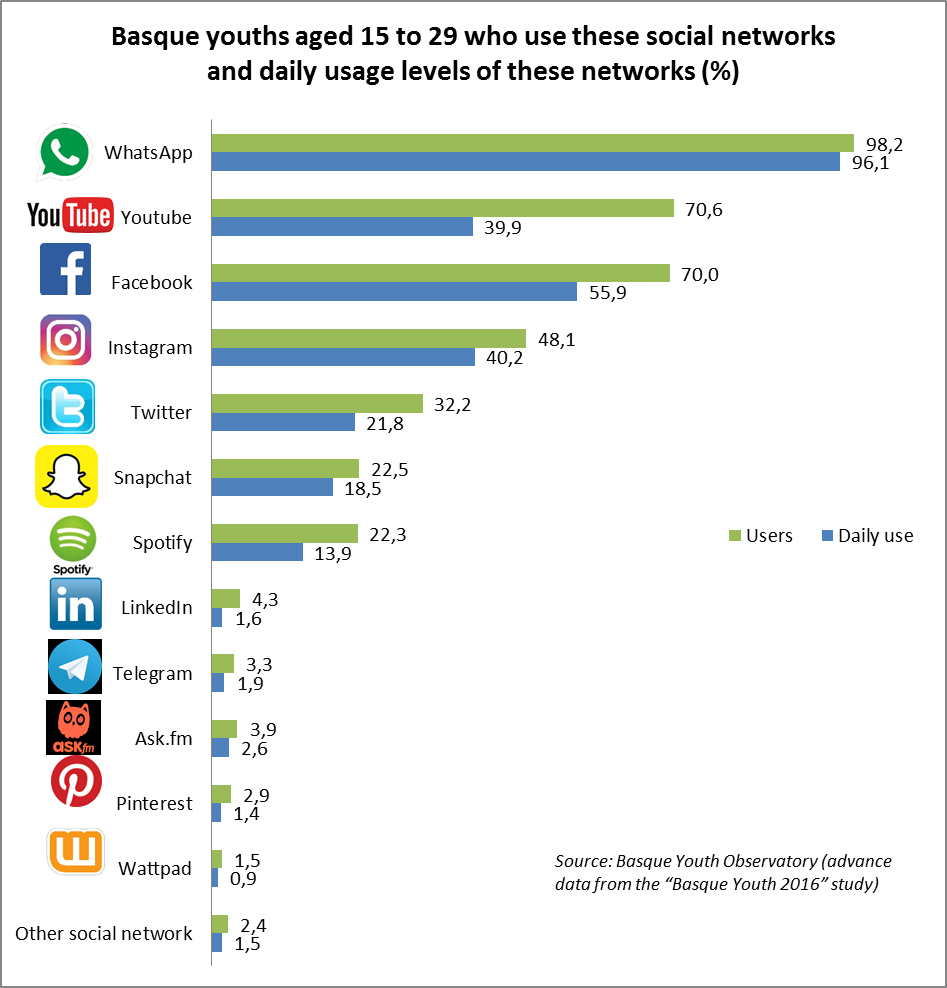
In any case, these are the general percentages for youth as a whole. However, we must stress the huge differences regarding the use of these networks by girls and boys, by people under the age of 20 and people aged 20 to 29.
[up]
Girls prefer social networks that can be used to interact and share images
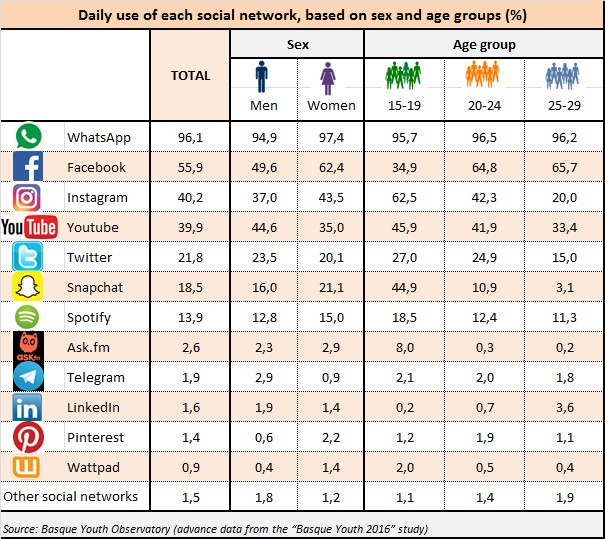
Based on the daily use of these social networks, a higher percentage of girls use Facebook, Instagram and Snapchat, while among boys we can underline the more extended daily use of Youtube).
Girls also present higher daily connection percentages to Spotify, Pinterest and Wattpad than boys while, on the other hand, they are less active on Twitter and Telegram.
[up]
After WhatsApp, Instagram is the most widely used social network by young people under 20, while older people prefer Facebook
Based on age, the youngest group (15-19) uses Instagram more often (which is, after WhatsApp, the network most widely used by young people under 20 on a daily basis), as well as YouTube, Snapchat, Twitter, Spotify, Ask.fm and Wattpad.
On the other hand, the 25 to 29 group uses LinkedIn more often and, as do people aged 20 to 24, Facebook. In fact, after WhatsApp, Facebook is the network most widely used by Basque people aged 20 and over on a daily basis.
An age-based ranking would reveal that the social network most widely used by people under the age of 20 (after WhatsApp) is Instagram, followed by YouTube and Snapchat. Facebook would be fifth, with just over one third of this group using it every day.
After WhatsApp, people aged 20 to 24 prefer Facebook (almost doubling the daily percentage of people under the age of 20), followed by Instagram (20 points less than the percentage among youngest boys and girls), YouTube and Twitter. Snapchat would be relegated to seventh, after Spotify, with a fall in daily users of more than 30 points.
Finally, the social network most widely used by the 25 to 29 age group, after WhatsApp (which holds the leading position in all age groups), is Facebook, followed at a distance by YouTube and Instagram (with a fall of another 20 points). Then come Twitter and Spotify. Snapchat is hardly used by people aged 25 to 29. It is even lower on the scoresheet, behind LinkedIn, which is starting to be used by people over the age of 25.
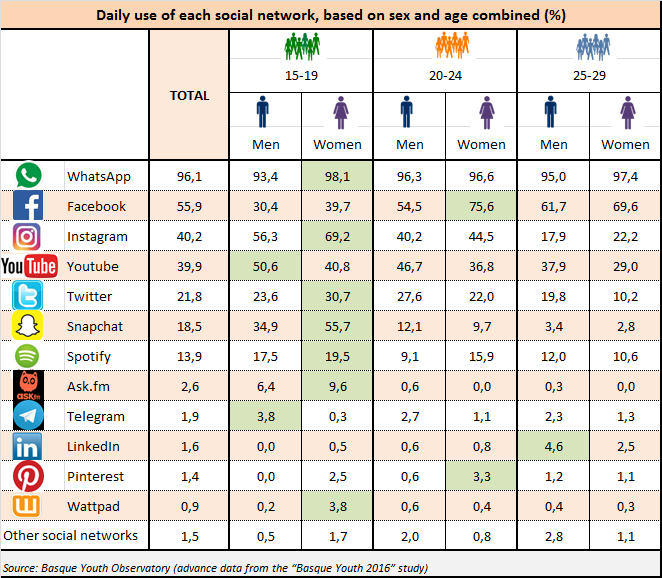
If we cross-reference sex and age, we can identify the specific groups that use each network more widely. This will enable us to establish a user profile for each one of them.
Girls aged 15 to 19 are great “fans” of social networks. They present the highest percentages of daily connection to seven of the twelve networks proposed: WhatsApp, Instagram, Snapchat, Twitter, Spotify, Ask.fm and Wattpad from higher to lower percentage of daily connection.
The case of Twitter is surprising. Despite being used more widely by boys overall, this analysis reveals that the highest connection percentages are found among girls aged 15 to 19.
On the other hand, the Facebook user profile consists of women aged 20 to 24. Boys aged 15 to 19 represent the Youtube user profile and men aged 25 to 29 are the profile of daily user of LinkedIn.
[up]
Young people connect to three social networks each day on average. The favourite combination is WhatsApp, Facebook and YouTube
In general, the youngest group (15-19) uses social network most. They connect to 3.4 networks on average every day. People between 20 and 24 connect to 3 networks on average each day, a figure that falls to 2.5 among people in the 25 to 29 group.
The most commonly repeated combination of social networks visited every day (we are listing three, as the average number of networks to which young people say they connect daily) is WhatsApp, Facebook and YouTube. 23.5% of young people use three networks each day.
The next most popular combination includes WhatsApp, Facebook and Instagram. 8% of young people connect to these three every day. The third most commonly used combination is WhatsApp, Facebook and Twitter (7.1% of young people).
These data refer to youth in general. If we focus on people under the age of 20, the most commonly used daily combination is WhatsApp, Instagram and Snapchat.
[up]
Last year, slightly more than one third of young people used social networks to promote or disseminate discussions or report issues
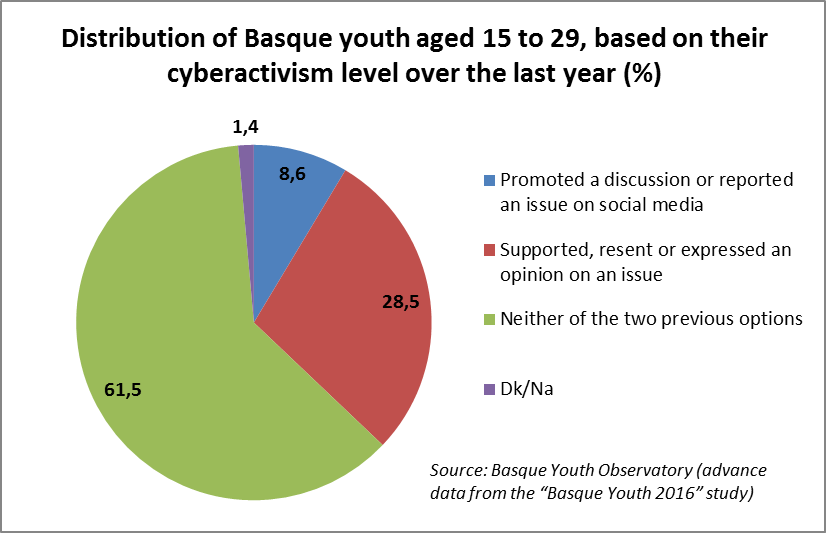
Just over one third of Basque youth (37.1%) used social networks to promote a discussion, report a situation and support or give their opinion on an issue last year.
The number of people who state they promoted a discussion or reported an issue by writing a text and/or posting an image or video are fewer (8.6%) than those who say they supported an issue, resent a text or image or expressed their opinion (28.5%).
[up]
Cyber activism increases with age, studies, interest in politics and the wish to engage in public affairs
As age increases, cyber activism increases. This is understood as the use of social networks to promote discussions or report issues as well as to support, resend or express an opinion on those issues. Last year, 33.2% of young people aged 15 to 19 used social networks for this purpose. Among young people aged 20 to 24, the percentage was 37.3% while in the 25 to 29 age group, it was 40.0%.
Besides age, it was noted that young people with higher studies promoted or supported Internet discussions or complaints more than people without such studies. Among people with higher studies, the group that used the Internet for these purposes more often were people with university qualifications (49.3%).
There are no differences on this issue between boys and girls. However, an interest in politics is decisive in this case. Most people who state they are very or quite interested in politics (57.2%) say they have promoted or supported discussions on social networks. This figure falls to 12% among those who say they have little or no interest in politics.
Among young people who say they would like to participate more actively in public affairs, half (53.0%) state they have promoted or supported discussions or reported issues on social networks over the last year. Among people who say they “already participate enough”, this percentage is 42.7%, but falls to 21.7% among those who do not wish to take part in these issues.
[up]
Using social networks may also expose people to rejection or bullying, such as being expelled from WhatsApp groups, impersonation on a social network or the dissemination of compromising or humiliating images.
The most frequently used form of harassment on social networks is excluding someone from WhatsApp groups
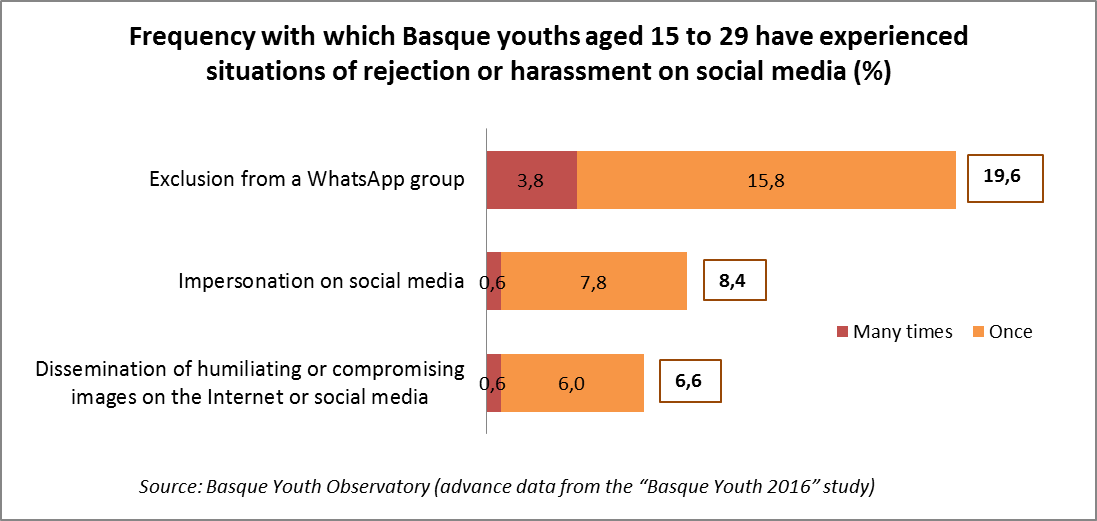
One in every five youths (19.6%) say they have been excluded from a WhatsApp group. 3.8% state this had happened many times while 15.8% say that it has happened to them on some occasion.
Considering those who stated they have been excluded from a WhatsApp group, whether once or several times, we find that this situation is more frequent among young men than young women (22.8% and 16.3%, respectively). It also appears to happen more often in the youngest group and decreases with age: 30.5% of youths aged 15 to 19 say they have been expelled from a WhatsApp group, 17.5% among people aged 20 to 24 and 12.6% among people in the 25 to 29 age group.
8.4% of young people say their identity has been hijacked on social networks: 0.6% say it has happened to them many times and 7.8% say it has only happened to them on some occasion.
6.6% of young people state that other people have uploaded or disseminated a compromising or humiliating video or photograph on the Internet or social networks without their permission. Once again, 0.6% say that this has happened to them many times while 6.0% reveal it has happened to them on some occasion.
There does not appear to be any difference based on sex or age regarding cases of impersonation or the dissemination of compromising images.
Considering the frequency they experience these situations as a criterion to measure severity, there are two categories:
- The first, called “cyberbullying”, includes people who have experienced one (or several) of these three experiences on many occasions.
-
The second, that we have called “cyber-rejection”, includes people who have experienced one of them on some occasion.
[up]
4.5% of Basque youth have experienced harassment on social networks
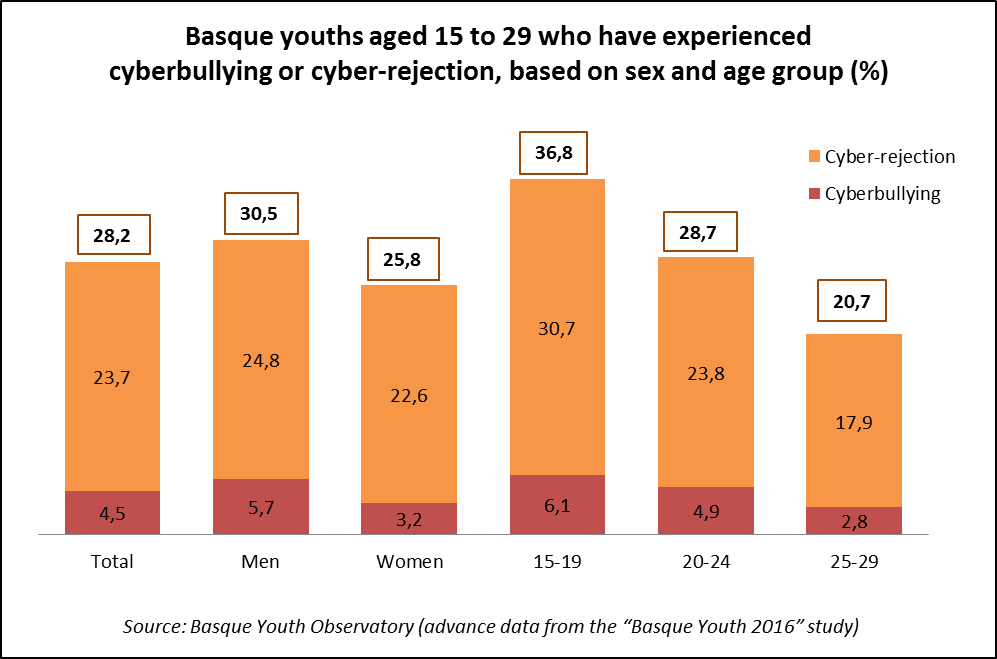
According to these definitions, 4.5% of young Basque people have experienced some type of cyberbullying and another 23.7% have experienced “cyber-rejection”. In all, 28.2% of young people have experienced some type of personal rejection or harassment on social networks.
Boys have experienced more cyberbullying situations than girls (5.7% compared to 3.2%). Cyberbullying is more frequent among people in the youngest age group, where 6.1% of its members have experienced some type of bullying on social networks. The number of cases falls as age increases and these situations have been experienced by 4.9% of people aged 20 to 24 and by 2.8% of people in the 25 to 29 age group.
The groups that present the highest figures of cyberbullying (men and young people aged 15 to 19) are also the ones that present highest cyber-rejection figures. In other words, these groups are more likely to be exposed to risk situations when using social networks.
In addition, the experiences described can have effects on their health and psychological well-being. More than a quarter of young people who have experienced some type of cyberbullying or cyber-rejection say they have had psychological issues related to anxiety, stress or depression over the last year (28.4%). This is almost ten points higher than the average percentage of young people who had psychological problems last year (19.2%).
[up]
Almost all young people connect to any social network every day; on average, they connect to three social networks each day.
WhatsApp is the most used social network, with minor differences by sex or age groups.
After WhatsApp, Instagram is the most widely used social network by young people under 20, while among older people the second place in the ranking is for Facebook.
Snapchat is the social network with the youngest users; almost half of those aged 15 to 19 use it every day, but people aged 25 to 29 hardly connect to it.
In general, young people aged 15 to 19 are the main “consumers” of social networks, girls even more than boys.
4.5% of Basque youth have experienced bullying on social networks. The most frequently used form of cyberbullying is excluding someone repeatedly from WhatsApp groups. The 15-19 age group presents the highest figure of cyberbullying.
Last year, slightly more than one third of young people used social networks to promote discussions, report issues, support them or express their opinion about them. Cyber activism increases as age and interest in politics go up.
The source of these data is a survey conducted by the Basque Youth Observatory in 2016
These data come from a survey the Basque Youth Observatory conducted in the first quarter of 2016. It involved interviewing a representative sample of 1500 Basque youths aged 15 to 29. They were asked about a wide range of topics, including issues relating to social networks. The full results of the survey will be published in the “Basque Youth 2016” report, which is still being prepared.
[up]
Follow us on Facebook and Twitter!


