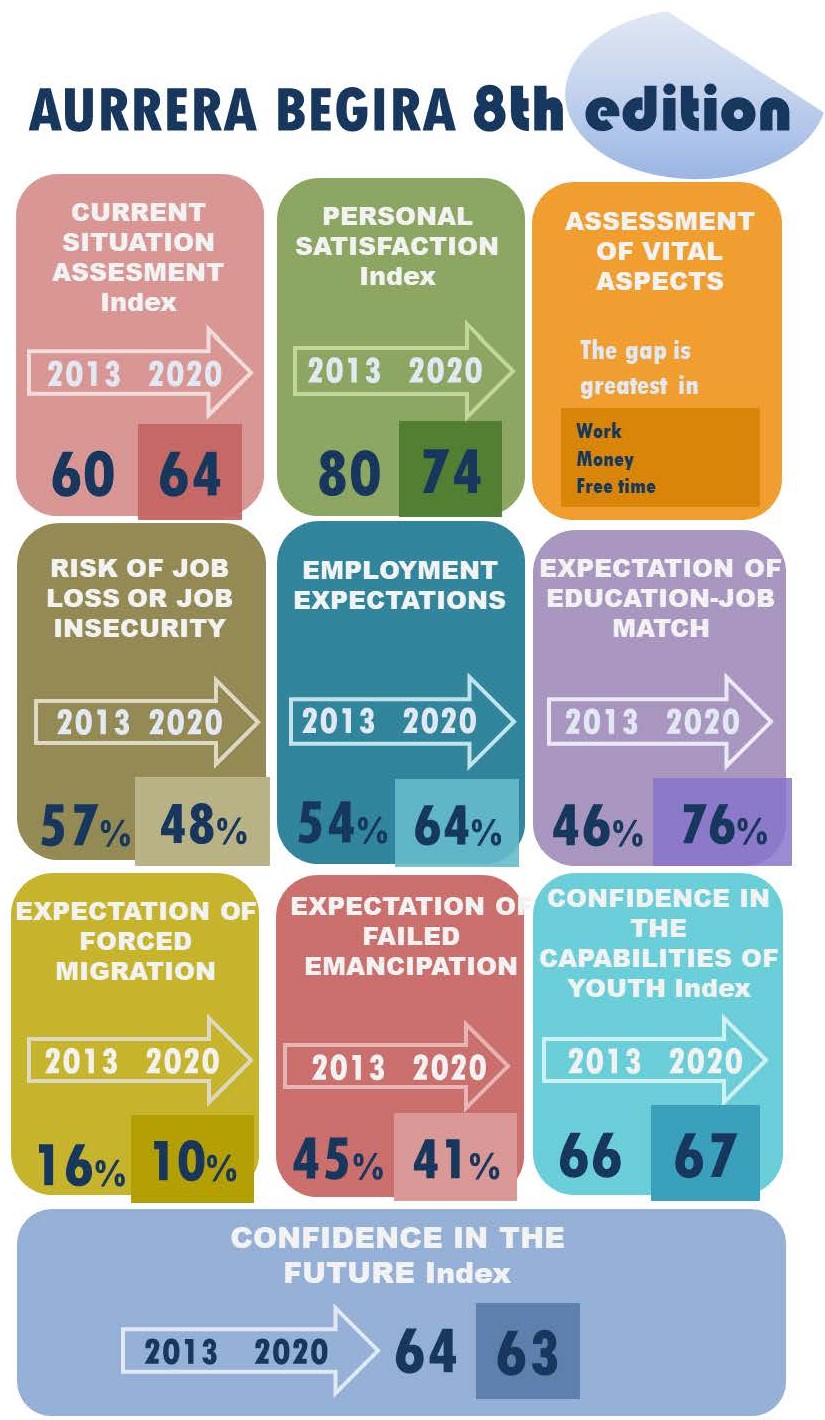
- However, Basque youth are satisfied with their current personal situation and, among young students, confidence in finding a job that matches their studies has risen to 76%.
- The Basque Youth Observatory is presenting the 8th edition of the study titled Aurrera Begira. Youth Expectation Indicators
- 6,341 interviews in November and December 2020
- Study available in Basque language and Spanish
 For eight years now, the Aurrera Begira study has been analysing how Basque youth perceive the present and their short term expectations for the future.
This study was designed as a concise instrument to assess the evolution of the issues that most concern young people: their careers, the possibility of becoming independent in the short term, or the need to migrate to find a job.
The study has been conducted every year since 2013. For the first time, the field work was carried out between November and December 2020 by means of an online survey of 6,341 young people aged 15 to 29.
Ten indicators to take stock of today’s situation of young people and their expectations for the future
The results of the Aurrera Begira study are based on 10 indicators. The first three indicators focus on the assessment of the present from various points of view: individually and as members of a group.
- Current situation assessment index
- Personal satisfaction index
- Assessment of vital aspects
Then, four indicators that focus on job prospects are assessed:
- Risk of job loss or job insecurity
- Employment expectations
- Expectation of education-job match
- Expectation of forced migration
Indicator number 8 refers to residential independence:
- Expectation of failed emancipation
Finally, two indicators focus on expectations for the future:
- Confidence in the capabilities of young people index
- Confidence in the future index
CONCLUSIONS
Basque youth are satisfied with their situation; in 2020, the personal satisfaction index, which combines the assessments of their work situation, studies, free time, friends, family, health, etc., stood at 74 out of 100. The score for this index in 2020 has fallen from previous years to the lowest figure in the series. This is due to a lower satisfaction level with the employment situation and job expectations, with available income... but, above all, with sentimental and/or sexual relationships, which were severely affected in 2020 by the lockdown resulting from the Covid19 pandemic.
The current situation assessment index, which not only takes into account the personal situation but also that of young people in general or the situation of the Basque Country as a whole, was 64 out of 100 and has also dropped from 2019 to 2020. In any case, it is still above the value recorded in 2013, when the first data were collected (60).
Employment-related indicators affecting young people in work or unemployed have worsened but remain better than at the start of the series in 2013. Among those in work, the risk of job loss or job insecurity has increased from 34% in 2019 to 48% in 2020, and this has been greatly affected by temporary redundancy plans, company closures, or activity shutdowns caused by the Covid19 pandemic. This score, however, is still almost ten points below the figure recorded in 2013 (57%). Among the unemployed, the expectation of finding a job has reversed its upward trend of recent years, with 64% of the unemployed believing that they will find a job within a year. Even so, this is still higher than in 2013 (54%).
In contrast, students’ expectation of finding a job that matches their studies has increased slightly and stands at 76%, the highest in the series (repeating the figure for 2018).
Among young people in general, the expectation of forced emigration abroad to work stands at 10%, i.e. one in ten people aged 15 to 29 in the Basque Country believe that, in the future, they will be forced to go and work abroad although they do not want to do so. The figure for 2020 is lower than that recorded in 2013 when the highest figure (16%) was registered.
On the other hand, the expectation of failed emancipation, i.e. wanting to become independent from the family home and not being able to do so, shows one of the lowest figures in the series (41%) and has hardly changed in relation to 2019, when it stood at 40%.
In any case, young people have confidence in the abilities of young people and the confidence index shows a figure of 67 out of 100. This index has hardly changed from the previous year (66) and is also practically the same as in 2013 (66).
Finally, the confidence in the future index, which measures expectations regarding their personal situation, that of young people in general and also of the Basque Country, in five years' time shows a positive value (63 out of 100) but has dropped when compared to previous years. Indeed, 2020 has registered the lowest score in the series.