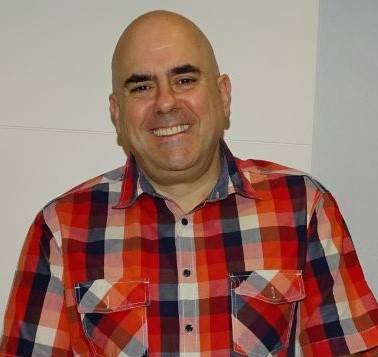
 Interview with Raúl García Piñeiro, founder of 'Sacodejuegos', creator of recreational experiences, consultant in pedagogical environments and coach in aspects related to the pedagogy of play.
- What is play for you?
It is difficult to explain in a few words. In fact, there are many "official" definitions of this term which, in my view, are incorrect in several respects because they do not define it in its full breadth. If I had to risk defining it in some way, I would say something along the lines of “it is a fun activity through which participants can acquire and strengthen their skills, abilities, competences and knowledge. Moreover, it can and should be adaptable, inclusive, motivating, flexible, liberating and socialising”.
- Do you think traditional forms of playing are in decline?
Absolutely. In recent years, a strange thing has been happening: Playing is being “used” less by the people in whom it should be more widely developed. On the contrary, it is being overused as a loyalty-promoting tool in all kinds of businesses. Humans have always played in their earliest stages as part of their development and growth process. Now, we do it less and less. There is excessive use of technology in family and educational settings to educate and manage children's emotions in the wrong way. Moreover, there is an inordinate interest in occupying all their free time to educate them and to give them greater intellectual and competitive skills.
On the other hand, digital leisure has led to a drastic decrease in free and traditional play time, which is of vital importance for their evolution as individuals and for that of our society. The current situation has made things even worse.
All these factors will create a problem in the medium/long term that is likely to lead to a worsening of social and ethical behaviour.
- What do you think is the answer?
I think that the solutions should be geared toward promoting spaces and times for play (non-digital play) for children of all ages. Increasingly, in our projects, we are coming across young people of all ages who “don’t know how to play” or who are not familiar with games or who are not used to managing their own fun. This is because the educators and families of young people are afraid of boredom, and boredom is one of the greatest boosters of creativity and of people's own development through play. Therefore, one solution would be to allow them more time to manage their own fun and another would be to create spaces for creative leisure based on traditional games and an effective methodology.
- How do you think leisure is currently being addressed in the case of young people and children?
In recent years, we have been involved in various bodies, institutions and associations and I have seen that there is a lot of work to be done. In the planning and design processes of projects to educate through play, people are either unaware that there is a methodology to do this or they do not want to invest (time or money) in doing so. There is a tendency to think that designing activities of this type is an effortless process because playing is a simple tool to manage or use, and that to do so, all you need is an inventory of activities designed “only” to entertain. This approach does not take into account other aspects that you should be aware of. This is one of the problems that educators and activity facilitators have: they do not consider the pedagogical and transformative capacity of play and in order to do so, they need a method and knowledge of different techniques if they want to do it effectively. In general, there are currently few play-based methodologies or they are completely unknown. The transformative power of play is amazing and to use it correctly you must be familiar with these methodologies and with their pedagogical capacity.
At Sacodejuegos, we do just that, we create recreational experiences of any kind and we support and help with their implementation to achieve a positive change in the participants, whatever their age and whatever their situation.
Digital video game companies, and by extension traditional companies, have realised this capacity, and are using it through various techniques to attract customers or to promote loyalty in the use of their services in a motivating and well-studied way. Generally, their goals are somewhat... self-serving and sometimes unethical.
- Is it this situation that has led you to work on your project? What do you want to achieve with Sacodejuegos?
Indeed, this situation and this loss of traditional play time, and above all the enthusiasm I feel for this type of activity, is what led me to launch this project. I believe that play can help to achieve a better society and can help to change behaviours and attitudes in a natural, fun and above all ethical manner.
Integration, equality, difference, and managing emotional intelligence are values that need to be strengthened in our society. I am convinced that play-based activities can help to work on these aspects in a voluntary way and with amazing results as long as they are correctly planned and structured. In short, that is our goal: to do our bit through training courses and recreational activities to participate in this social change that is so necessary today.