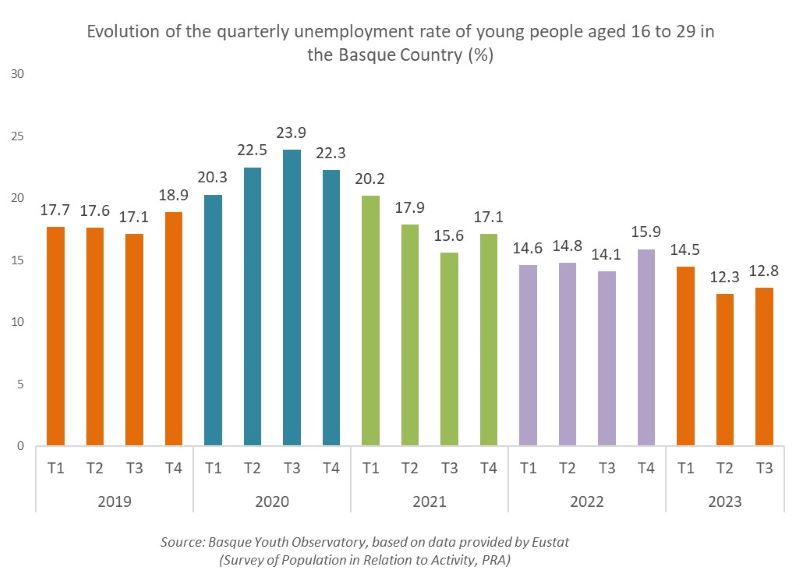
The unemployment rate for young people in the Basque Country in the third quarter of 2023 is 0.5 tenths higher than in the previous quarter, but 1.3 percentage points lower than in the same quarter of 2022.
These data come from the Population in Relation to Activity Survey (PRA) corresponding to the third quarter of 2023. The PRA is compiled quarterly by the Basque Statistics Institute (EUSTAT), which provides the Basque Youth Observatory with data on the population aged 16 to 29.
The unemployment rate indicates the percentage of active people (i.e. in a position to work) who do not have a job, but are actively looking for one and have carried out a job search in the last four weeks. It does not include students who are not looking for a job or disabled persons who are unable to work.
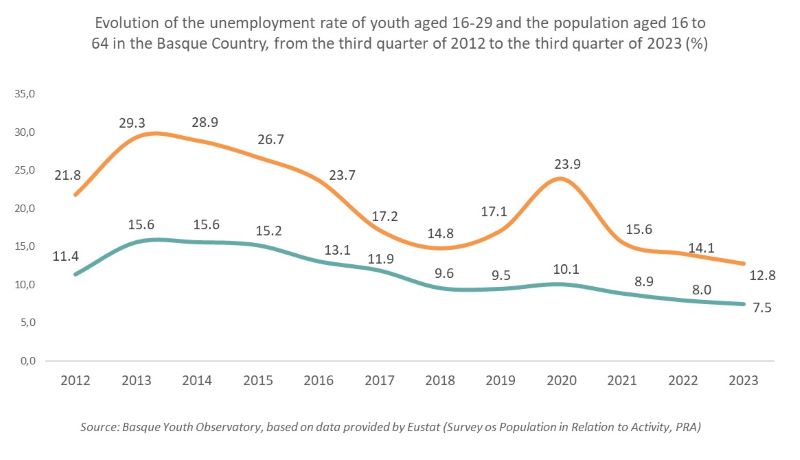
The evolution of the unemployment rate in the third quarters since 2012 shows that the current rate is the best in the last decade, even better than in the pre-pandemic years.
Although the gap between the unemployment rate of young people aged 16 to 29 and the unemployment rate of the population aged 16 to 64 in the Basque Country is narrowing since 2020, in the third quarter of 2023 it is still 5.3 points.
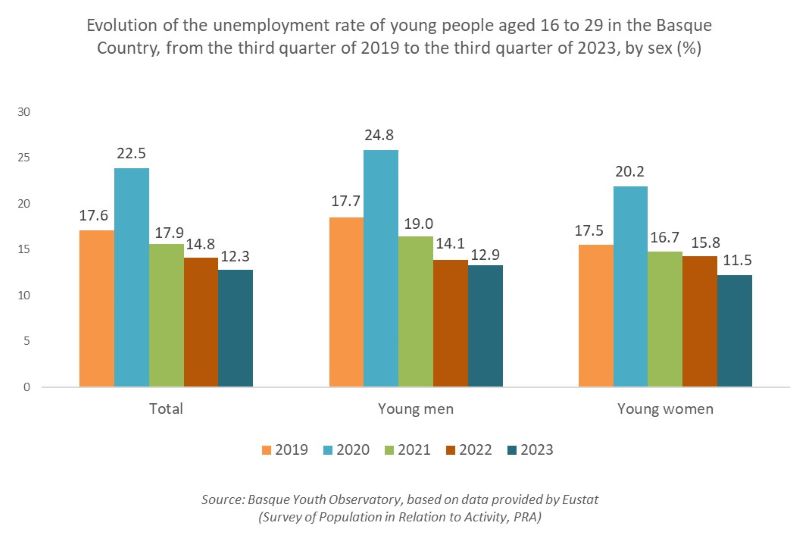
In the third quarter of 2023, the unemployment rate of young women (12.2%) is lower than that of young men (13.3%).
The analysis of the evolution of the unemployment rate of young women and young men in the third quarter of the year, from 2019 to 2023, shows that the unemployment rate of young women has fallen more than that of young men compared to the third quarter of 2022.
These data are directly linked to goal 8 of the 2030 Agenda for Sustainable Development Goals: "Decent work and economic growth" and, more specifically, to target 8.5: By 2030, achieve full and productive employment and decent work for all women and men, including for young people and persons with disabilities, and equal pay for work of equal value.