



CAVA GONZÁLEZ, Y., 2026. Between protection and autonomy: educational challenges in the face of growing concerns about the emotional well-being of children and adolescents. Supervision21, 81(81). ISSN 1886-5895. DOI 10.52149/Sp21/81.10.
The profound social, cultural and technological transformations experienced in recent decades have placed the emotional well-being of children and adolescents at the centre of educational debate. Growing concern for mental health and socio-emotional development has encouraged schools to adopt new responsibilities aimed at promoting student well-being. However, this evolution also raises important challenges related to balancing the protection of childhood with the progressive development of personal autonomy. This article reflects on this educational tension through an analysis of contemporary social changes and their impact on schools. It also examines the role of educational guidance and counselling as a key element in promoting emotionally healthy environments while fostering resilience, responsibility, coping skills and autonomy. Finally, the paper argues for a conception of emotional well-being that integrates support and challenge, protection and personal growth, contributing to the development of individuals capable of facing the challenges of the twenty-first century in a balanced and responsible way.
HERNANDO DE LA HERA, I., BEZANILLA ALBISUA, M.J. y GALINDO DOMÍNGUEZ, H., 2026. Análisis del perfil psicosocial de los roles del ciberbullying. Un estudio con adolescentes de Bizkaia y Gipuzkoa /Psychosocial profile analysis of cyberbullying roles. A study with adolescents from Bizkaia and Gipuzkoa. IKASTORRATZA e-journal on Didactics, no. 37, pp. 104. ISSN 1988-5911. DOI 10.37261/37_alea/5.
This study analyzes the prevalence and interrelation of cyberbullying roles (victim, bully and observer) in a sample of 639 adolescents from Bizkaia and Gipuzkoa. Using a quantitative, cross-sectional approach, we explore the influence of demographic variables on these dynamics (r = .629), evidencing mixed profiles, alongside a lack of gender-based differences. Furthermore, the observer role increases with age, peaking in the second year of Bachillerato. We conclude that although older students detect the phenomenon more effectively, they do not always intervene, potentially due to desensitization and diffusion of responsibility. These findings highlight the need to reorient educational interventions towards ethical literacy of observers.
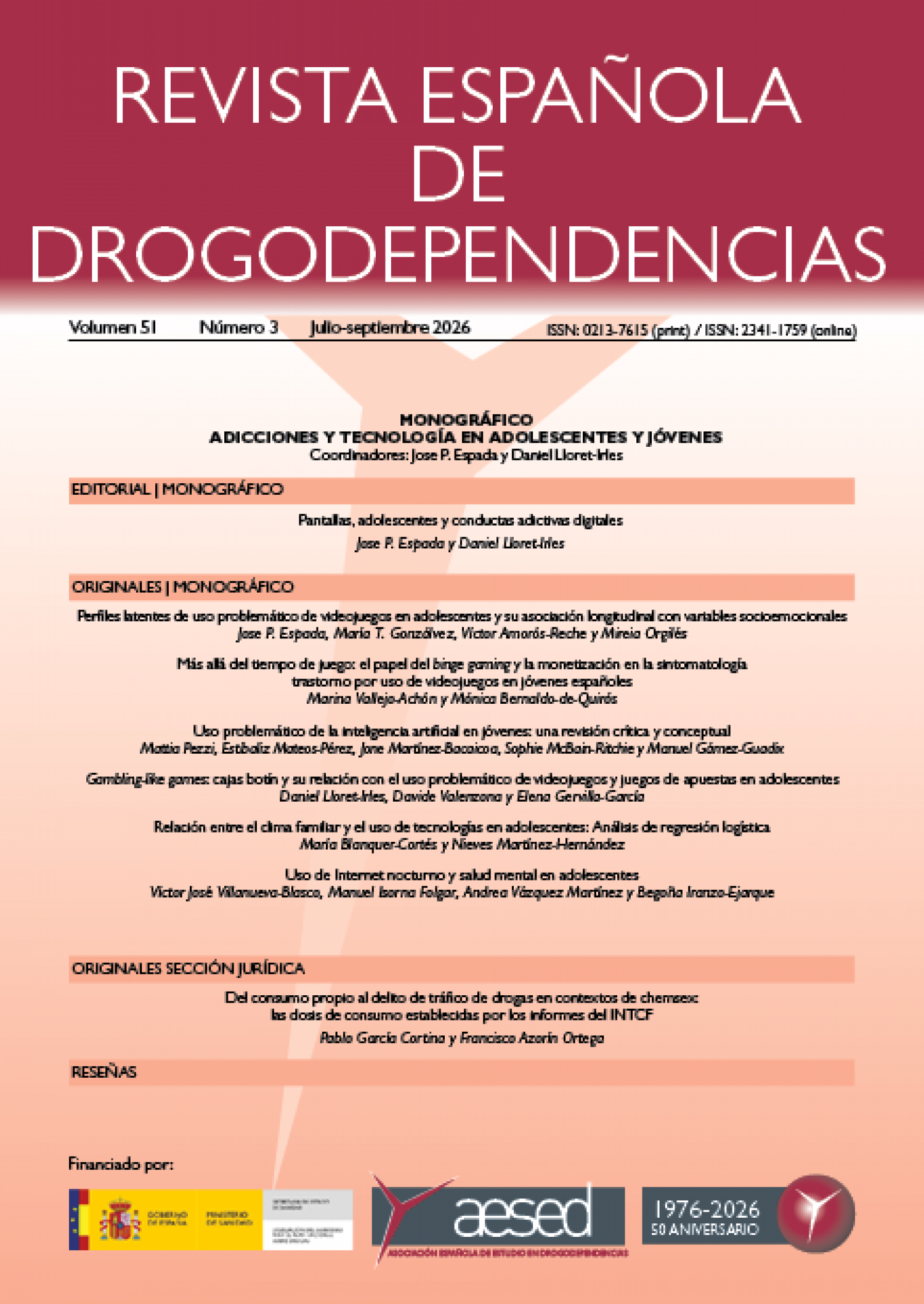
LLORET-IRLES, D., VALENZONA, D. y GERVILLA-GARCÍA, E., 2026. Gambling-like games: Loot boxes and their link to problematic video game and gambling behaviour among adolescents. Revista Española de drogodependencias, vol. 51, no. 3, pp. 109. ISSN 0213-7615, 2341-1759. DOI 10.54108/10143.
Loot boxes are monetization mechanisms incorporated into many video games that have attracted increasing research and regulatory attention due to their similarities with gambling. The aim of this study was to examine the association between the frequency of loot box use and problematic gaming, problem gambling, and depressive symptoms among adolescents. The sample comprised 3,700 adolescents aged 14–17 years from the Valencian Community, Spain (50.3% girls). Problematic gaming was assessed using the Game Addiction Scale for Adolescents (GASA), problem gambling with the Consumption Screen for Problem Gambling (CSPG), and depressive symptoms with the Center for Epidemiologic Studies Depression Scale (CES-D). Differences according to the frequency of loot box use were analyzed separately for boys and girls using one way analyses of variance (ANOVA). The results showed a significant association between loot box use and problematic gaming in both genders, with a substantially stronger association among girls. Frequent loot box use was also associated with higher levels of problem gambling among boys and with greater depressive symptoms among girls. These findings add to the growing evidence linking loot box use to indicators of psychological vulnerability during adolescence and support the development of preventive and regulatory measures aimed at reducing the potential harms associated with these monetization mechanisms in video games.
- Dokumentazio zentroko artikulu nabarmenduen historikoa
- Informazio gehiago: geb-liburutegia@euskadi.eus


